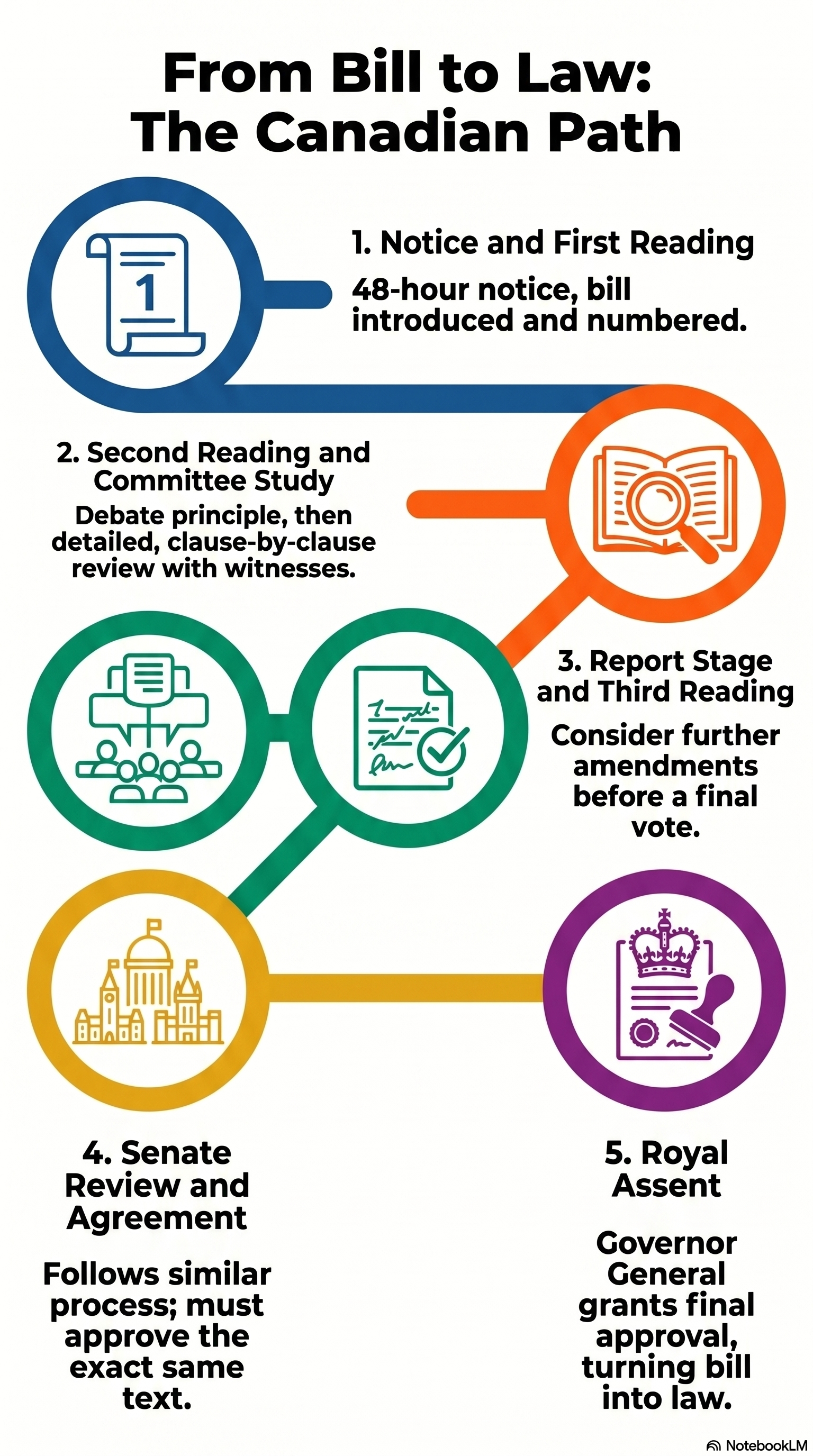
What kind of bill is it? Three types
Not all bills are equal. Where a bill comes from determines a lot about its odds of becoming law.
Government bills (numbered C-1 through C-200)
These are introduced by a Cabinet minister. They're drafted by lawyers at the Department of Justice and have the government's full weight behind them. Most laws in Canada come from government bills.
Private members' bills (C-201 through C-1000, or S-201+ in the Senate)
These come from any MP or senator who isn't in Cabinet — anyone from the opposition, backbench government MPs, or independents. They're drafted by House Legislative Counsel. Without government backing, they have a much harder path. Most never make it past second reading. But many of the most-debated bills (on assisted dying, citizenship rules, MP standards of conduct) start here.
Private bills (C-1001+)
Rare and narrow. These deal with one specific person or organisation — for example, letting a particular insurance company change its corporate structure. Most Canadians will never hear about a private bill.
A constitutional rule worth knowing. Any bill that proposes spending public money or raising taxes must start in the House of Commons — never the Senate. And it needs a "Royal Recommendation" from the government before its third-reading vote. This is why budget bills always come from the government — only ministers can request the Royal Recommendation.
Stages 1–3 · The House of Commons
Notice and introduction
Before a bill can be introduced, the MP or minister gives written notice 48 hours ahead. The bill's title shows up on what's called the Notice Paper, then moves to the Order Paper, and then it's ready to be tabled.
When the bill is actually introduced in the House, that's called First Reading. Nothing happens at this stage other than the bill being formally placed on the record. There's no debate. The sponsor of a private member's bill is allowed to give a short summary; ministers usually don't bother. After first reading, the bill is printed and made public.
Second reading — the principle debate
This is the first real debate. MPs argue about whether the idea behind the bill is a good one — not the specific wording, just the general direction. The text can't be amended at this stage. Everyone is either for the principle or against it.
A few procedural moves can derail a bill here:
- The Hoist — postpone consideration for 3 or 6 months, which effectively kills the bill
- A Reasoned Amendment — refuse to give second reading for a specific stated reason (for example, "this bill discriminates against…")
- Direct referral to committee — skip the floor debate and send it straight to committee
If second reading passes, the bill is officially "approved in principle" and moves to committee.
Stage 4 · Committee — where the real work happens
This is where bills are actually built or broken. The bill goes to a Standing Committee made up of MPs from all parties. The committee:
- Hears witnesses — Cabinet ministers, the bill's sponsor, experts, advocacy groups, community members, lawyers, anyone who has something to say
- Goes through the bill clause-by-clause — every section gets a separate vote, and MPs can propose amendments to any part
- Reports back to the House with the bill in whatever shape it's now in (which may be very different from how it went in)
Why committee matters for ordinary Canadians. This is the stage where public testimony shapes the law. Citizens, civil society groups, and experts can request to appear or submit written briefs. If you want to influence a bill, the committee stage is your best opportunity.
Stages 5–6 · Report Stage and Third Reading
Report stage
The full House looks at the bill again, but only debates the changes the committee made. The Speaker groups proposed amendments together so the House can vote efficiently. Amendments that were already considered (and rejected) in committee usually aren't allowed back.
If no amendments are proposed at report stage, the bill skips this debate entirely and goes straight to third reading. Bills can sometimes pass report and third reading on the same day.
Third reading
This is the final debate in the House. By now everyone knows the bill inside and out. The argument is about whether to send this exact text to the Senate. Only narrow procedural amendments are allowed — no new content can be introduced.
When third reading passes, the bill is "adopted" by the House. The Clerk certifies it. A message is sent to the Senate asking them to consider it.
Stage 7 · The Senate
The Senate runs the exact same six-stage process the House just ran — first reading, second reading, committee, report, third reading. The Senate exists as a chamber of "sober second thought," looking for problems the House might have missed.
Three things can happen:
- The Senate passes the bill unchanged. A message goes back to the House and the bill heads to Royal Assent.
- The Senate makes amendments. The amended text goes back to the House. The House either accepts the changes or sends a message saying "we disagree." If both sides keep disagreeing, they exchange messages until one chamber yields. The Senate usually yields eventually, accepting the House's elected mandate.
- The Senate kills the bill. This is rare but constitutionally allowed.
Important rule. A bill cannot proceed to Royal Assent until both chambers have agreed on the exact same text, word for word.
Stage 8 · Royal Assent
Once both chambers agree on identical text, the bill goes to the Governor General for Royal Assent. This is the final step that turns a bill into an Act of Parliament — actual law.
There are two ways Royal Assent happens:
- Written declaration (the modern, most common way) — the Governor General signs the bill, and notifications are sent to both Speakers. The Act takes effect the day both Houses are notified.
- Traditional ceremony in the Senate — the Usher of the Black Rod summons the House to the Senate Chamber, the Clerk reads the bill titles, and the Governor General gives assent with a nod. Rare these days, used for ceremonial occasions.
Stage 9 · Coming Into Force
Just because a bill gets Royal Assent doesn't mean it immediately changes anything. The Act has to "come into force" — and that can happen one of three ways:
- Immediately on Royal Assent — the default if the bill doesn't say otherwise
- On a date written in the bill itself — e.g., "this Act comes into force on January 1, 2027"
- On a date set by Cabinet order — the government decides when (and sometimes never does)
This last option is why some passed laws never actually take effect — Cabinet just doesn't bring them into force.
Where Canadians fit in
You don't have to be an MP to influence Canadian law. Here are the real entry points:
- Talk to your MP when a bill is being debated — letters, emails, and constituency meetings demonstrably affect votes, especially for backbench MPs and on free-vote bills
- Submit a brief or request to appear at committee — Standing Committees publish their schedules; written briefs are accepted and become part of the public record
- Sign an e-petition — see our separate explainer on how e-petitions work
- Vote in elections — controls who gets to introduce bills and which government bills get a Royal Recommendation
- Engage publicly — letters to editors, op-eds, social media advocacy, and civil society organizing all shape the political environment a bill faces